

The Millennium era of the Godzilla franchise ran from 1999 to 2004 and consists of six films released by Toho Studios: Godzilla 2000, Godzilla vs. Megaguirus, Godzilla, Mothra and King Ghidorah: Giant Monsters All-Out Attack, Godzilla Against MechaGodzilla, Godzilla x Mothra x MechaGodzilla: Tokyo S.O.S., and Godzilla: Final Wars. Unlike the interconnected Heisei era that came before it, most Millennium-era entries function as standalone stories that ignore previous sequels and branch off from the events of the original 1954 Gojira. This approach allowed filmmakers to experiment with different versions of Godzilla, new interpretations of classic monsters, and wildly different tones from one film to the next. Some of those experiments worked better than others. To see how the entire era stacks up, here’s our ranking of all six Millennium-era Godzilla movies, from worst to best.
Millennium Era Godzilla Movies (1999–2004)
- Godzilla 2000 (1999)
- Godzilla vs. Megaguirus (2000)
- Godzilla, Mothra and King Ghidorah: Giant Monsters All-Out Attack (2001)
- Godzilla Against MechaGodzilla (2002)
- Godzilla x Mothra x MechaGodzilla: Tokyo S.O.S. (2003)
- Godzilla: Final Wars (2004)

6. GODZILLA: FINAL WARS (2004)
- Release Year: 2004
- Director: Ryûhei Kitamura
- Main Monsters: Godzilla, Monster X/Keizer Ghidorah, Gigan, Mothra, Rodan, Anguirus, King Shîsâ, Kumonga, Kamacuras, Ebirah, Zilla, Minilla
- Why It’s Ranked Here: Ambitious and packed with fan service, but the story is overlong, overly chaotic, and burdened by distracting Matrix-inspired elements.
- Best Feature: The sheer scale of the monster roster and Godzilla’s dominance over classic foes.
- Biggest Weakness: The human storyline and mutant/Xilien plot often overshadow the kaiju action.
As Toho prepared to celebrate Godzilla’s 50th anniversary in 2004, they recognized that box office returns for the Millennium era films were declining and decided the franchise should once again go dormant. To mark the occasion, they hired director Ryûhei Kitamura to craft Godzilla: Final Wars into an all-star celebration of the franchise. Conceived as the cinematic equivalent of a greatest-hits album, the film combines monsters, characters, and concepts from across Godzilla and Toho’s broader kaiju catalog with the largest budget in series history. Set in an alternate 2004 where decades of wars and environmental damage have led to frequent monster attacks, the story introduces the Earth Defense Force and its mutant-powered Organization M. Godzilla, a recurring threat since 1954, is imprisoned beneath Antarctic ice by the drill-equipped submarine Gotengo.
The plot follows a soldier as he becomes entangled in a global alien conspiracy. While investigating a 12,000-year-old mummified creature that turns out to be Gigan, he learns from Mothra’s Shobijin that Earth’s mutants share a genetic link with both Gigan and the alien Xiliens. Soon afterward, monsters begin attacking cities across the world, including Rodan, Anguirus, King Shîsâ, Kamacuras, Kumonga, Ebirah, and even Zilla, the creature from the 1998 American Godzilla. The Xiliens claim they have come to save Earth from the approaching asteroid Gorath, but their true goal is to conquer humanity, manipulate Earth’s mutants through their shared genetic heritage, and harvest human life. Godzilla has to be freed from his icy prison so he can be unleashed against the alien-controlled kaiju. What follows is an extended victory lap for the King of the Monsters, who dispatches a parade of classic foes with ease before facing upgraded versions of Gigan and Monster X, which eventually transforms into a new incarnation of King Ghidorah. Mothra joins Godzilla in the climactic battle and our soldier hero, who happens to be a mutant/human hybrid, confronts the Xiliens.
Godzilla: Final Wars didn’t fare well with Japanese audiences. The movie was designed to be a bigger and better Godzilla movie, shot at locations around the world with a lot of monsters and action, and moviegoers didn’t turn out for it. It had the highest budget of the series and at the box office it was the least successful Godzilla film since Terror of MechaGodzilla. This definitely proved to Toho that they needed to let the franchise rest for a while. And it’s not difficult to see why the film failed. It’s goofy and scattered, too long with too many moments influenced by The Matrix. Still, there is some fun to be had here. There are a lot of callbacks to the great Godzilla movies and other Toho tokusatsu/kaiju movies of the past. Even though the story is told in a very 2004 way, it is a classic Godzilla set-up, and Goji himself is treated with respect. Godzilla is the only thing that can save us in a world that’s being destroyed by monsters that can’t stand up to him at all. That’s a very honorable take.

5. GODZILLA VS. MEGAGUIRUS (2000)
- Release Year: 2000
- Director: Masaaki Tezuka
- Main Monsters: Godzilla, Megaguirus, Meganulon, Meganula
- Why It’s Ranked Here: Filled with intriguing concepts and alternate-history ideas, but the execution never lives up to its potential.
- Best Feature: Creative science fiction concepts like Dimension Tide and the alternate Godzilla timeline.
- Biggest Weakness: The story makes many of its most interesting ideas feel inconsequential.
Godzilla vs. Megaguirus doesn’t just continue the Millennium era’s approach of discarding continuity, it goes even further by existing in its own alternate universe. Directed by Masaaki Tezuka in his feature directorial debut and written by Hiroshi Kashiwabara and Wataru Mimura, the film rewrites Japan’s history with Godzilla. In this version, Godzilla first attacked Tokyo in 1954, returned in 1966 to destroy Japan’s first nuclear power plant, and later resurfaced in 1996 to attack Osaka after the development of plasma energy. By 2001, Japan has abandoned both nuclear and plasma power and formed a specialized anti-Godzilla military force called the G-Graspers.
The G-Graspers are working on Dimension Tide, an experimental weapon designed to open a black hole and trap Godzilla forever. During a test firing, a wormhole briefly opens and allows a prehistoric giant insect to emerge and lay an egg. That egg hatches large, bloodthirsty insects called Meganulon, which then molt into winged Meganula, a type of dragonfly. These monsters are a new take on the prehistoric pests that first appeared in 1956’s Rodan. These bugs multiply rapidly, eventually swarming Godzilla, draining energy from him so they can transform their queen into Megaguirus.
As with Godzilla 2000, the monster battle in this film ends with Godzilla pulling off a finishing move that is cheer-worthy. Unfortunately, the movie around that moment isn’t cheer-worthy. There are some very interesting ideas in Godzilla vs. Megaguirus, but the execution of them is dull and lifeless and the fights aren’t very good. Nearly everything in the movie feels like it’s rendered pointless by the storytelling. The alternate history created is intriguing, but has no real bearing on what happens. Dimension Tide is an intriguing idea, but it really accomplishes nothing. This isn’t a bad movie, it’s kind of fun, but it comes off like a missed opportunity. If you’re going to build an alternate universe for a Godzilla movie, you can do more with it than this.

4. GODZILLA 2000 (1999)
- Release Year: 1999
- Director: Takao Okawara
- Main Monsters: Godzilla, Orga
- Why It’s Ranked Here: An important franchise relaunch that successfully restored Godzilla’s image after 1998, but it lacks the creativity and depth of the era’s stronger entries.
- Best Feature: Bringing the Japanese Godzilla back with a striking redesign and classic monster action.
- Biggest Weakness: A simplistic story and an antagonist that never becomes particularly memorable.
When Godzilla was killed off in Godzilla vs. Destoroyah (1995), Toho intended to keep the Japanese version of the character off screens until his 50th anniversary in 2004 while TriStar pursued a planned trilogy of American films. However, the poor reception of TriStar’s Godzilla (1998) inspired Toho to fast-track a new Japanese production so they could restore Godzilla’s reputation. They brought the King of the Monsters back to theatres just nineteen months after the disappointment of TriStar’s movie. Directed by Takao Okawara from a screenplay by Hiroshi Kashiwabara and Wataru Mimura, a creative team that all had credits in the Heisei era, Godzilla 2000 launched the Millennium era of the franchise, and a different approach was taken to this one, as the films of the Millennium era largely throw continuity out the window. Their stories may harken back to the original Gojira, but all of the other movies are ignored. Only two entries in this era even have continuity with each other.
The story follows reporter Yuki Ichinose and members of the Godzilla Prediction Network, Yuji Shinoda and his daughter Io, who track Godzilla’s movements across Japan. They’re basically the Godzilla version of storm chasers. Their work coincides with the discovery of a mysterious object on the ocean floor that turns out to be an ancient alien spacecraft. After scanning humanity and studying Godzilla’s biology, the alien within becomes fascinated by the regenerative “Organizer G1” cells that allow the monster to heal rapidly. It reveals plans to transform Earth into its own “Millennium Kingdom,” and ultimately attempts to use Godzilla’s genetic material to create a physical body for itself. The alien evolves first into Millennian (looking like an alien octopus) and then into the kaiju Ogra (which has some Godzilla to its appearance), leading to the film’s climactic battle with Godzilla in Tokyo.
Godzilla 2000 received a wide theatrical release in the United States, making it the first Japanese Godzilla film to do so since Godzilla 1985. For that fact, and because it brought the real Godzilla back to the screen after he had seemingly been “killed off,” Godzilla 2000 is a somewhat special installment in the franchise. However, it’s not one of the best. There’s not much to this film. It was a rushed production, and that shows through. The story is as simplistic as it gets and, for a lot of the running time, rather dull. The saucer/Millennian/Ogra isn’t a particularly interesting opponent for Godzilla to face off with, either. The old school effects on display are great, but the CG is lacking. It’s adequate overall, but there’s not much in there that goes beyond adequate.

3. GODZILLA AGAINST MECHAGODZILLA (2002)
- Release Year: 2002
- Director: Masaaki Tezuka
- Main Monsters: Godzilla, Kiryu (MechaGodzilla)
- Why It’s Ranked Here: Delivers some of the best action in the Millennium era and introduces an excellent new version of MechaGodzilla, but its story feels incomplete.
- Best Feature: The concept of Kiryu being built around the skeleton of the original 1954 Godzilla.
- Biggest Weakness: Thin character development and a plot that feels like setup for a larger story.
Following the Millennium-era introductions of Mothra and King Ghidorah in Godzilla, Mothra and King Ghidorah: Giant Monsters All-Out Attack, Toho turned to another fan-favorite monster: MechaGodzilla. Written by Wataru Mimura and directed by Masaaki Tezuka, Godzilla Against MechaGodzilla continues the Millennium tradition of ignoring all previous Godzilla films except the original Gojira (1954). In this continuity, Godzilla was killed by Dr. Serizawa’s Oxygen Destroyer and reduced to a skeleton resting in Tokyo Bay. While other giant monsters have wreaked havoc in Japan (the original Mothra film and 1966’s The War of the Gargantuas are both included in this movie’s cherry picked continuity) there was never another appearance of Godzilla… until 1999. After a battle with the Anti-Megalosaurus Force, the new Godzilla returned to the sea.
To prepare for Godzilla’s inevitable return, the Japanese government creates Kiryu, a new MechaGodzilla built around the skeleton of the original 1954 Godzilla. Designed as a “bio-robot” that combines advanced technology with Godzilla’s DNA, Kiryu takes four years to complete, but it’s ready when Godzilla shows up again. The robot appears capable of defeating him until Godzilla’s roar awakens the memories embedded within the original skeleton, causing Kiryu to go berserk and attack Tokyo itself. Luckily, the robot is brought back into working condition in time for an extended climactic showdown – and when Godzilla manages to fry its remote control system, an Anti-Megalosaurus Force soldier takes manual control of the robot to avenge fallen comrades.
Godzilla Against MechaGodzilla is about as simplistic as a Godzilla movie can get. It’s basically three action sequences strung together with some sparse character work. It felt like Mimura and Tezuka were trying to get by with the bare minimum of character stuff so they could really focus on MechaGodzilla/Kiryu. Because of this, the film moves through its 88 minute running time very quickly. There’s never a dull moment, things are always getting propelled toward the next battle. So it’s a very fun movie that provides exactly what you really want when you put in a Godzilla movie. (Unless you don’t like the entries in which Godzilla is a villain and want to stick with his more heroic adventures.) Monsters fight, miniatures are destroyed, things blow up, and the viewer is entertained. Still, in the end it feels sort of lacking, like only half of a story was told here. It’s no surprise it got a direct sequel.

2. GODZILLA x MOTHRA x MECHAGODZILLA: TOKYO S.O.S. (2003)
- Release Year: 2003
- Director: Masaaki Tezuka
- Main Monsters: Godzilla, Kiryu (MechaGodzilla), Mothra, Mothra Larvae
- Why It’s Ranked Here: Builds on the Kiryu storyline while adding stronger thematic material through Mothra and the legacy of the 1954 Godzilla.
- Best Feature: The conflict over whether humanity should continue using the remains of the original Godzilla.
- Biggest Weakness: Minimal character development outside of the central Kiryu storyline.
Although Godzilla Against MechaGodzilla was originally conceived as a standalone film, director Masaaki Tezuka felt there was more story to tell and successfully pushed for a direct sequel. Co-writing the screenplay with Masahiro Yokotani, Tezuka crafted Godzilla x Mothra x MechaGodzilla: Tokyo S.O.S., the only Millennium-era film to directly continue the events of its predecessor. Set just months later, the film largely leaves behind the previous movie’s main characters and instead focuses on a Kiryu ground crew mechanic, who is determined to repair MechaGodzilla despite concerns that the bio-robot may not want to fight Godzilla again.
As Kiryu’s repairs near completion, Mothra returns to Japan accompanied by the Shobijin, who deliver a warning to the mechanic’s uncle, who happens to be Shin’ichi Chūjō from the original Mothra (Hiroshi Koizumi reprises the role). According to the fairies, building Kiryu around the bones of the 1954 Godzilla was a violation of nature, and the remains must be returned to the sea. If humanity refuses, Mothra will defend Japan from Godzilla herself, and may even declare war on mankind. The warning is ignored, and when Godzilla begins moving toward Japan, it becomes clear that he is being drawn to the bones of his predecessor. Mothra teams with Kiryu in a battle with Godzilla that dominates the running time – and along the way, the spirit of the original 1954 Godzilla awakens within Kiryu and is able to communicate with the mechanic.
Like the movie it follows, Tokyo S.O.S. is exceptionally simplistic. The filmmakers got by with doing as little character work as they had to in Godzilla Against MechaGodzilla, and that approach carries over into this film. It’d be impossible to do less with some of these characters and still be able to call them characters. The bulk of what you can call story happens in the first half hour; the remaining hour is nothing but battle. Still, what’s in that first half hour is more interesting than anything in Godzilla Against MechaGodzilla, largely because it feels like a welcome return to the Shōwa-era style. More than forty years had passed, but it plays like a solid follow-up to the 1961 Mothra. Mothra being upset about the desecration of a fellow kaiju’s bones makes total sense – and, unlike in Giant Monsters All-Out Attack, Mothra is classic Mothra here. Then the action begins and never lets up. This is a good movie and quite entertaining; it could have been better and the structure could have been improved, but it’s an enjoyable way to spend an hour and a half as it is.
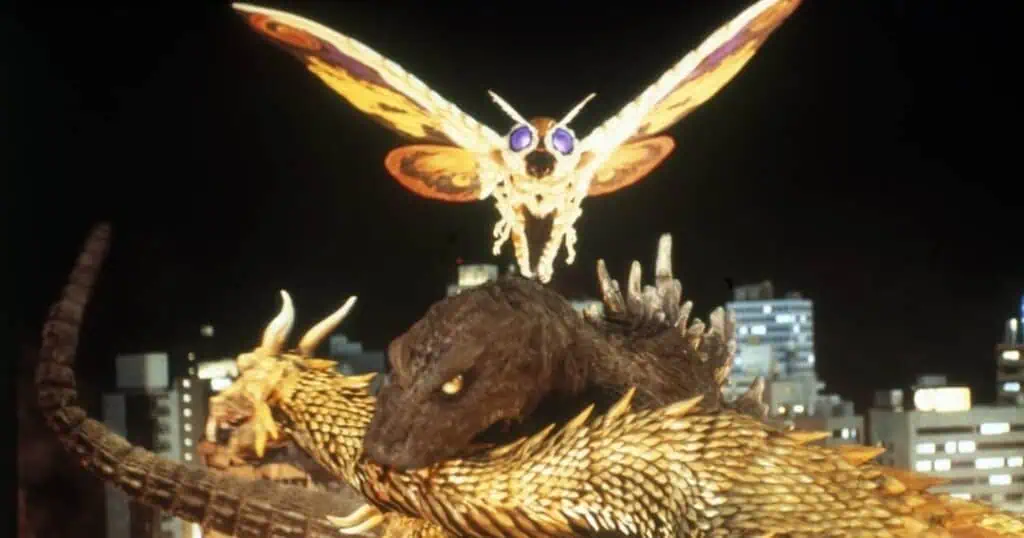
1. GODZILLA, MOTHRA AND KING GHIDORAH: GIANT MONSTERS ALL-OUT ATTACK (2001)
- Release Year: 2001
- Director: Shûsuke Kaneko
- Main Monsters: Godzilla, Mothra, King Ghidorah, Baragon
- Why It’s Ranked Here: The boldest and most creative film of the Millennium era, reimagining Godzilla and his fellow monsters while delivering strong themes and spectacular action.
- Best Feature: Its unique portrayal of Godzilla as a supernatural force fueled by the spirits of the war dead.
- Biggest Weakness: The reworked versions of Mothra and King Ghidorah may frustrate viewers who prefer traditional continuity.
For the third Millennium-era film, Toho brought in director Shûsuke Kaneko, who had previously earned acclaim directing a trilogy of Gamera films for Daiei. After abandoning an early concept involving a virus-mutated astronaut battling Godzilla, Kaneko developed a more ambitious story that returned Godzilla to his villainous roots while pitting him against three guardian monsters. His original lineup of Baragon, Varan, and Anguirus was altered at Toho’s request, with Mothra and King Ghidorah replacing Varan and Anguirus. The result was Godzilla, Mothra and King Ghidorah: Giant Monsters All-Out Attack (GMK), a film that completely reboots continuity, acknowledging only the original Gojira (1954) while taking a playful jab at the 1998 American Godzilla movie. It establishes that Godzilla did attack Tokyo in 1954, but that attack has been followed by nearly fifty years of peace and prosperity in Japan. A monster attacked New York in 1998 and Americans claim it was Godzilla, but Japanese officials have doubts about that.
The story follows television reporter Yuri Tachibana as she investigates strange events linked to ancient legends of Japan’s Guardian Monsters. As Godzilla reemerges from the sea and marches toward Tokyo, Yuri learns that this version of the monster is far more than a prehistoric creature empowered by radiation. He is possessed by the restless souls of those who died during World War II, returning to punish a nation that has forgotten the suffering of the past. Opposing him are Baragon, Mothra, and King Ghidorah, reimagined as mystical protectors of Japan whose spirits are awakened by an elderly doomsayer. Unlike the heroic portrayal seen in other films, GMK‘s Godzilla is depicted as a force of pure evil, with blank white eyes and a willingness to kill civilians at every opportunity – and Baragon, Mothra and King Ghidorah are the heroes that have to stop him.
If you’re a stickler for continuity and consistency in characters, GMK is not going to be the movie for you. If you can accept that it completely reworks the origins of the monster characters, it’s quite an enjoyable monster movie, even if it does go on for too long. The “inhabited by spirits” angle is an interesting approach, and the attempt to return to the roots of the franchise is an admirable one. There are nice references to Gojira ’54 throughout, and the special effects are incredible. This is an installment that goes all out in trying something new, taking full advantage of the Millennium era’s “do whatever you want” style, which is respectable. Kaneko committed to making the movie as if no other Mothra or King Ghidorah story had been told before, while also including nods here and there to show he knew what came before. His creation of an alternate history for these creatures makes sense for his story. It works, and the film is a commendable effort.
Millennium Era Godzilla Movies FAQ
What is the Millennium era of Godzilla?
The Millennium era refers to the six Japanese Godzilla films released by Toho between 1999 and 2004. Unlike the Heisei era, most Millennium films ignore previous sequels and function as standalone continuities that branch off from the original 1954 Gojira.
What is the best Millennium-era Godzilla movie?
In this ranking, Godzilla, Mothra and King Ghidorah: Giant Monsters All-Out Attack (2001) takes the top spot thanks to its unique story, darker portrayal of Godzilla, strong themes, and creative reinvention of classic monsters.
What is the worst Millennium-era Godzilla movie?
Godzilla: Final Wars ranks last in this list. While its massive monster roster and ambitious scope are impressive, the film’s lengthy runtime and chaotic storytelling prevent it from reaching the heights of the era’s strongest entries.
Which Millennium-era Godzilla movies are connected?
Only Godzilla Against MechaGodzilla (2002) and Godzilla x Mothra x MechaGodzilla: Tokyo S.O.S. (2003) share a direct continuity. The other Millennium films largely function as standalone stories.
Why did the Millennium era end?
After the release of Godzilla: Final Wars in 2004, Toho placed the franchise on hiatus due to declining box office returns. The series remained dormant until the release of Shin Godzilla in 2016.
All 15 Shōwa Era Godzilla Movies Ranked Worst to Best
Every Heisei Godzilla Movie Ranked, From Worst to Best
MonsterVerse Movies Ranked: From Worst to Best
The post Millennium Era Godzilla Movies Ranked: All 6 Films From Godzilla 2000 to Final Wars appeared first on JoBlo.


No comments:
Post a Comment