
Before the cinematic universes of both Marvel and DC, the superhero genre was a scattered dartboard of “who knows how this is going to do at the box office.” For every Batman (1989) directed by Tim Burton, there was a The Punisher (1989) from Cannon Films. Instead of interconnected worlds and guaranteed franchises, audiences got throwbacks and one-offs like The Phantom, The Crow, The Shadow, and Darkman. Only one of those is secretly, or not so secretly, a horror movie too.
Darkman was a shot at major studio redemption for its creators. It went through multiple rewrites, a difficult casting process, and a challenging shoot and edit. And yet, somehow, miraculously, it still ended up with a shockingly long legacy.
The film hit number one at the box office and became wildly successful in spite of itself, bringing heavy horror vibes to a hero who doesn’t hesitate to kill or let people die. This is Darkman, and more than three decades later, it’s still the best horror superhero movie ever put to screen.
How Darkman Almost Didn’t Happen
It’s honestly amazing where Darkman ended up, considering how easily it could have failed. It never reached the heights of Batman or Batman Returns, but it surpasses nearly everything that came before it and holds up better than most entries in the Marvel or DC film catalogs. Its would-be successors stumbled. Jonah Hex failed outright, while Dylan Dog: Dead of Night never really got a fair shot. Yet somehow, Darkman became a franchise and even expanded into multiple forms of media.
So where did it all start?

Ironically, Sam Raimi originally wanted to make a movie about The Shadow. But Universal Pictures owned the rights and wasn’t interested in handing them over. So Raimi did what Raimi does, he created his own version.
In the early 1980s, he developed the idea for Darkman, starting with a short story about a man who could change his face. That evolved into a 40-page treatment about a hero who had lost his face entirely. Raimi has claimed it wasn’t meant to be horror, but his inspirations say otherwise: The Hunchback of Notre Dame, The Phantom of the Opera, and the classic Universal monster movies of the 1930s and 1940s.
He may see it as tragedy. But let’s be honest, it’s horror. And it’s the best superhero horror movie ever made.
A Writing Process That Shouldn’t Have Worked
In 1987, Raimi pitched the project to Universal, which greenlit it with a modest $8–12 million budget. The script, however, became a bit of a nightmare.
Films with too many writers usually turn into a mess. But here, Raimi assembled a surprisingly strong group: Joel Coen and Ethan Coen, his brother Ivan Raimi, and writers Daniel and Joshua Goldin. After 12 drafts, Raimi finally had a shooting script packed with ideas, characters, and a tone that somehow held together. And while the horror might not scream off the page, it absolutely comes alive on screen, rooted in a distinctly 1940s noir-horror sensibility.
Horror in Style, Sound, and Substance
That tone starts immediately with the opening credits, backed by a sweeping score from Danny Elfman. It feels almost like a Tim Burton film, complete with operatic emotion and gangster imagery, but then it pivots into something darker. After a deliberately over-the-top opening, a blood-curdling scream carries us into the story.
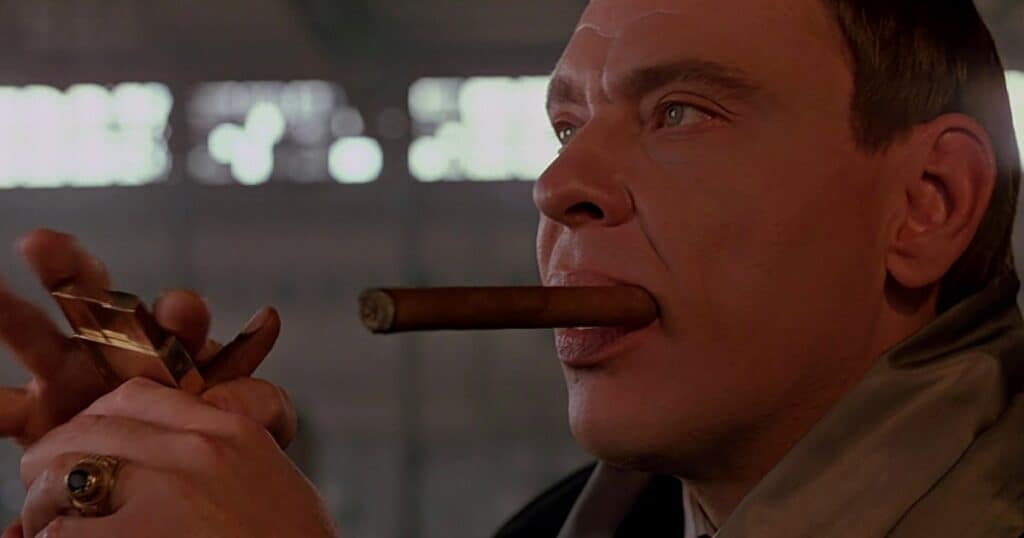
At first, it plays like a detective story with a touch of romance. But once Larry Drake’s Durant and his crew confront Dr. Peyton Westlake, played by Liam Neeson, the horror fully kicks in.
Westlake isn’t just beaten. He’s tortured in his own lab, his skin melting before he’s blown up in an explosion that should have killed him.
Body Horror Done Right
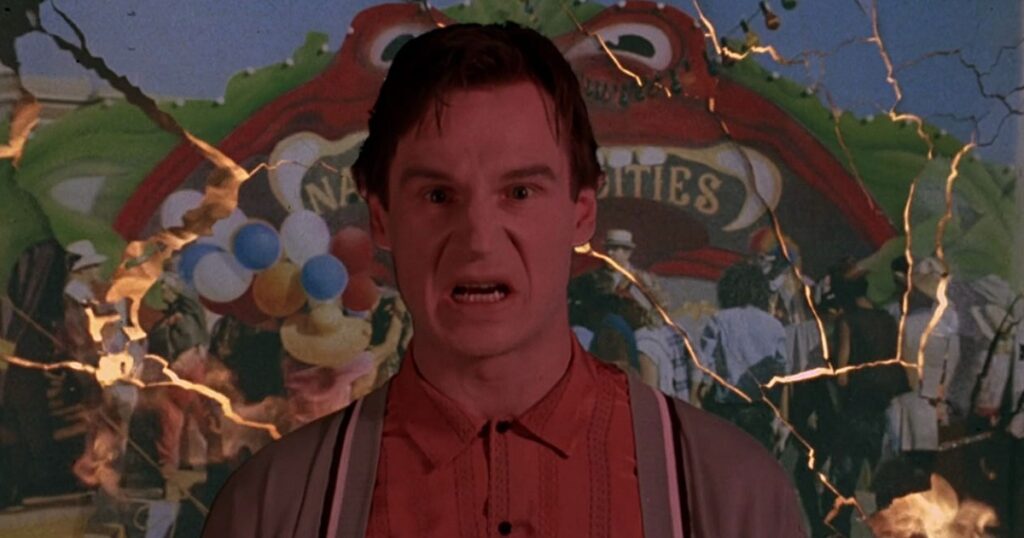
The special effects lean hard into horror, and they work. Unlike later attempts like Jonah Hex, which relied on weak CGI, Darkman uses practical effects to make Westlake’s condition genuinely disturbing. His melted features, exposed wounds, and unstable synthetic skin all create a sense of physical discomfort.
There’s even a strange, almost Ray Harryhausen-like quality to some of the effects; uncanny and tactile in a way CGI rarely achieves. The closest comparison might be Clayface from Batman: The Animated Series, but Darkman is far more unsettling.
The Real Horror: What He Lost
The physical damage is only part of it. Westlake loses everything: his work, his identity, and his relationship with Julie, played by Frances McDormand. Worse, he loses the ability to feel. And as the film explains, when physical sensation disappears, emotional control starts to unravel.
What we get is a man teetering on the edge, one who snaps violently and unpredictably. Raimi visualizes this with his signature style: rapid zooms, distorted imagery, and flashes of something monstrous lurking beneath the surface. This isn’t just a revenge story. It’s a psychological breakdown.
Carnival Chaos and Pure Raimi Energy
One of the film’s most infamous scenes happens at a carnival. Trying to reconnect with Julie, Westlake attempts something simple: winning her a prize. When the carny refuses, he snaps. What follows is one of the most bizarre and memorable moments in the film: screaming, finger-breaking chaos that feels more like Evil Dead II than a superhero movie.
It’s absurd. It’s violent. It’s horror-comedy at its finest.
A Monster, Not a Hero
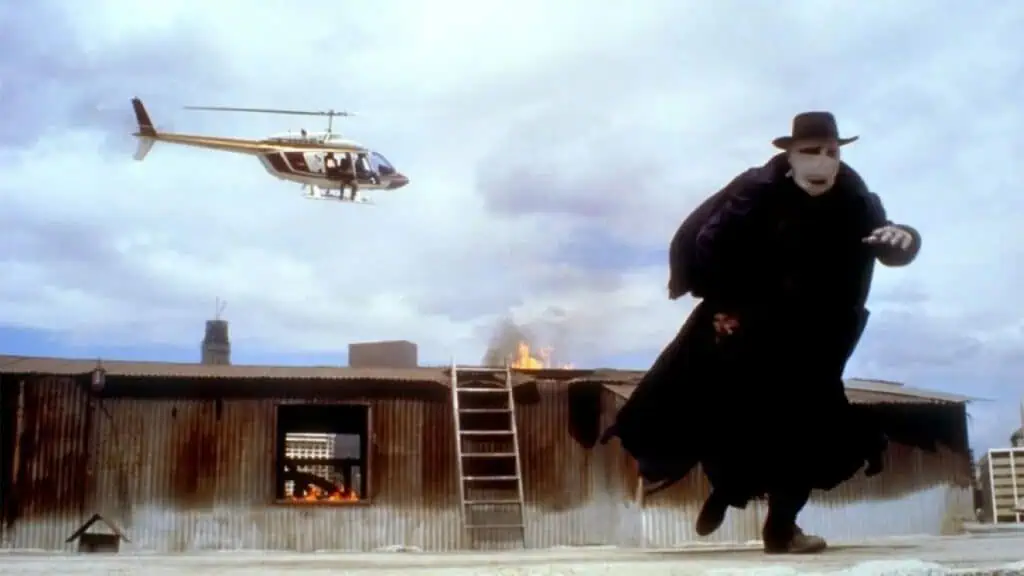
Darkman borrows heavily from classic Universal horror. Westlake’s abandoned factory becomes his gothic castle. He lurks in shadows, stalking those who wronged him. But unlike Batman, he doesn’t stop at intimidation. He kills. Brutally.
Whether it’s dropping a man into traffic or watching another fall to his death with disturbing satisfaction, Westlake crosses every line. By the end, he’s not a hero. He’s a monster shaped by tragedy, and fully aware of it.
A Surprise Hit with a Lasting Legacy
Against all odds, Darkman was a hit. It earned around $48 million on a $14 million budget and was well received by critics and audiences alike. After the struggles of The Evil Dead films and the failure of Crimewave, Raimi had finally delivered a major studio success. And more importantly, he created something unique: a superhero film that fully embraces horror.
Sequels, Spin-Offs, and Strange Afterlives
No one expected Darkman to become a franchise, but it did. It spawned two direct-to-video sequels: Darkman II: The Return of Durant and Darkman III: Die Darkman Die, both starring Arnold Vosloo.
There was also an unproduced TV pilot, a video game released on platforms like the NES and Game Boy, and even comic book crossovers, including one with Evil Dead.
It never got a toy line or cartoon, which feels like a missed opportunity.
Final Thoughts
Darkman was well received in 1990 and it still holds up today. It’s everything you want from a Sam Raimi film: inventive, chaotic, funny, and just a little unhinged. But more than that, it’s still the best horror superhero movie ever made.
The post Darkman (1990): The Best Horror Superhero Movie Ever Made appeared first on JoBlo.


No comments:
Post a Comment